Showing posts with label indicator. Show all posts
Friday, April 30, 2010
Naming of latent variable indicators in WarpPLS
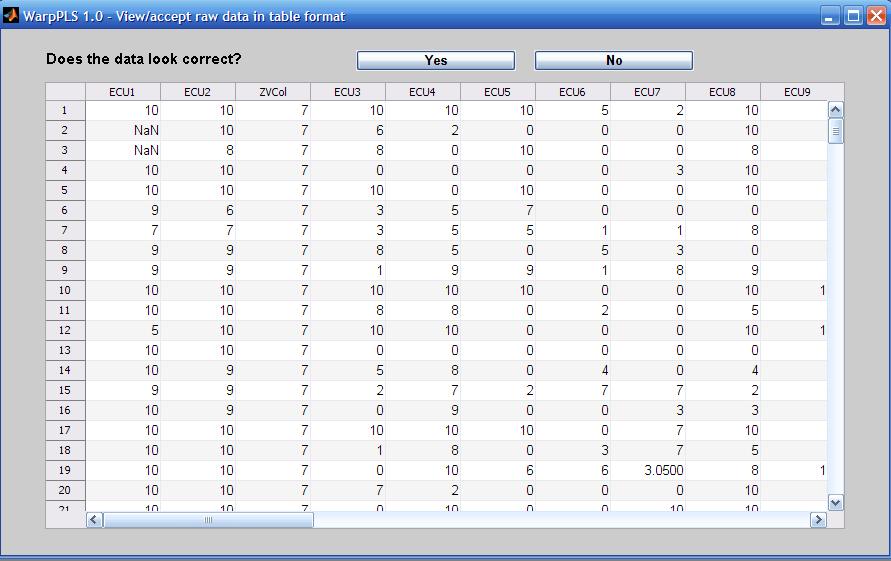
The indicator names are the headings of your raw data file, which are also shown on a few software screens during Step 2. That is the step where you read the raw data used in the SEM analysis. The indicator names are displayed at the top of the table on the figure below, a screen from Step 3; click on it to enlarge.
The software does not force users to restrict the names of indicators to a set number of characters (e.g., seven), or to exclude certain types of characters (e.g., blank spaces) from them. Nevertheless, it is usually a good idea to follow a few simple rules when naming indicators:
- Make the indicator names 7 characters in length, or less. This will ensure that they will not take up too much space on various screens and reports. In fact, in reports saved in text files, any character after the seventh is removed by the software. Otherwise the text file will become difficult to read without manual editing.
- Name the indicators using their latent variable name as a reference, and using sequential numbers at the end. For example, indicators that refer to the latent variable “ECU” should be named: “ECU1”, “ECU2”, “ECU3”, and so on.
- Do not use blank spaces in the indicator names. If you do, and an indicator name is long, the software may show the indicator split on two different rows on the model screen (Step 4), when you choose to show indicators on the model.
Saturday, January 30, 2010
Reflective and formative latent variable measurement in WarpPLS
A reflective latent variable is one in which all the indicators are expected to be highly correlated with the latent variable score. For example, the answers to certain question-statements by a group of people, measured on a 1 to 7 scale (1=strongly disagree; 7 strongly agree) and answered after a meal, are expected to be highly correlated with the latent variable “satisfaction with a meal”. The question-statements are: “I am satisfied with this meal”, and “After this meal, I feel good”. Therefore, the latent variable “satisfaction with a meal”, can be said to be reflectively measured through two indicators. Those indicators store answers to the two question-statements. This latent variable could be represented in a model graph as “Satisf”, and the indicators as “Satisf1” and “Satisf2”.
A formative latent variable is one in which the indicators are expected to measure certain attributes of the latent variable, but the indicators are not expected to be highly correlated with the latent variable score, because they (i.e., the indicators) are not expected to be highly correlated with one another. For example, let us assume that the latent variable “Satisf” (“satisfaction with a meal”) is now measured using the two following question-statements: “I am satisfied with the main course” and “I am satisfied with the dessert”. Here, the meal comprises the main course, say, filet mignon; and a dessert, a fruit salad. Both main course and dessert make up the meal (i.e., they are part of the same meal) but their satistisfaction indicators are not expected to be highly correlated with each other. The reason is that some people may like the main course very much, and not like the dessert. Conversely, other people may be vegetarians and hate the main course, but may like the dessert very much.
If the indicators are not expected to be highly correlated with one anoother, they cannot be expected to be highly correlated with their latent variable’s score. So here is a general rule of thumb that can be used to decide if a latent variable is reflectively or formatively measured. If the indicators are expected to be highly correlated, then the measurement model should be set as reflective in WarpPLS. If the indicators are not expected to be highly correlated, even though they clearly refer to the same latent variable, then the measurement model should be set as formative.
Labels:
formative,
indicator,
latent variable,
reflective,
warppls
Friday, January 22, 2010
Why are pattern cross-loadings so low in WarpPLS?
I have recently received a few related questions from WarpPLS users. Essentially, they noted that the pattern loadings generated by WarpPLS were very similar to those generated by other PLS-based SEM software. However, they wanted to know why the pattern cross-loadings were so much lower in WarpPLS, compared to other PLS-based SEM software.
Low cross-loadings suggest good discriminant validity; a type of validity that is usually tested via WarpPLS using a separate procedure, involving tabulation of latent variable correlations and average variances extracted.
Nevertheless, low cross-loadings, combined with high loadings, are a "good thing" (generally speaking) in the context of a PLS-based SEM analysis.
The pattern loadings and cross-loadings provided by WarpPLS are from a pattern matrix, which is obtained after the transformation of a structure matrix through an oblique rotation (similar to Promax).
The structure matrix contains the Pearson correlations between indicators and latent variables, which are not particularly meaningful prior to rotation in the context of measurement instrument validation (e.g., validity and reliability assessment).
In an oblique rotation the loadings shown on the pattern matrix are very similar to those on the structure matrix. The latter are the ones that other PLS-based SEM software usually report, which is why the loadings obtained through WarpPLS and other PLS-based SEM software are very similar. The cross-loadings though, can be very different in the pattern (rotated) matrix, as these WarpPLS users noted.
In short, the reason for the comparatively low cross-loadings is the oblique rotation employed by WarpPLS.
Here is a bit more information regarding rotation methods:
Because an oblique rotation is employed by WarpPLS, in some (relatively rare) cases pattern loadings may be higher than 1, which should have no effect on their interpretation. The expectation is that pattern loadings, which are shown within parentheses (on the "View indicator loadings and cross-loadings" option), will be high; and cross-loadings will be low.
The combined loadings and cross-loadings table always shows loadings lower than 1, because that table combines structure loadings with pattern cross-loadings. This obviates the need for a normalization step, which can distort loadings and cross-loadings somewhat.
Also, let me add that the main difference between oblique and orthogonal rotation methods (e.g., Varimax) is that the former assume that there are correlations, some of which may be strong, among latent variables.
Arguably oblique rotation methods are the most appropriate in PLS-based SEM analysis, because by definition latent variables are expected to be correlated. Otherwise, no path coefficient would be significant.
Technically speaking, it is possible that a research study will hypothesize only neutral relationships between latent variables, which could call for an orthogonal rotation. However, this is rarely, if ever, the case.
See the most recent version of the WarpPLS User Manual (linked below) for more details.
http://www.scriptwarp.com/warppls/#User_Manual
See the most recent version of the WarpPLS User Manual (linked below) for more details.
http://www.scriptwarp.com/warppls/#User_Manual
Labels:
correlation,
cross-loadings,
indicator,
latent variable,
loadings
Tuesday, December 29, 2009
Solve indicator problems in WarpPLS: YouTube video
A new WarpPLS YouTube video is available:
http://www.youtube.com/watch?v=G49aIm-14kU
This video shows how problems with indicators that load poorly on their latent variables, and that have high cross-loadings, can be solved in a structural equation modeling (SEM) analysis using the software WarpPLS.
Enjoy!
Labels:
collinearity,
cross-loadings,
indicator,
loadings,
YouTube video
Subscribe to:
Posts (Atom)